Those returning from the Grand Tour rarely came home empty-handed.
Travelling to Italy required considerable time, money and effort. For young aristocrats, artists and wealthy travellers, the Grand Tour was not merely a journey, but an investment in education, social standing and cultural refinement. For precisely that reason, travellers wished to bring back tangible reminders of their experiences.
These objects were far more than simple souvenirs. They served as evidence of education, taste and worldly knowledge. A collection displayed at home demonstrated to visitors that one had travelled extensively, studied classical civilisation and belonged to an international cultural elite. Collecting therefore became an integral part of the journey itself.
From Memory to Collection
During the course of the eighteenth century, a vast market emerged for souvenirs, antiquities and collectors’ objects. Artists, dealers and craftsmen responded cleverly to this growing demand. In cities such as Rome, Florence and particularly Naples, entire industries developed around producing objects specifically intended for foreign travellers. Not everything that was purchased was genuinely antique. Many objects were created especially for Grand Tour visitors — something that today has become particularly fascinating for collectors.
Cabinets of Curiosities and the Culture of Collecting
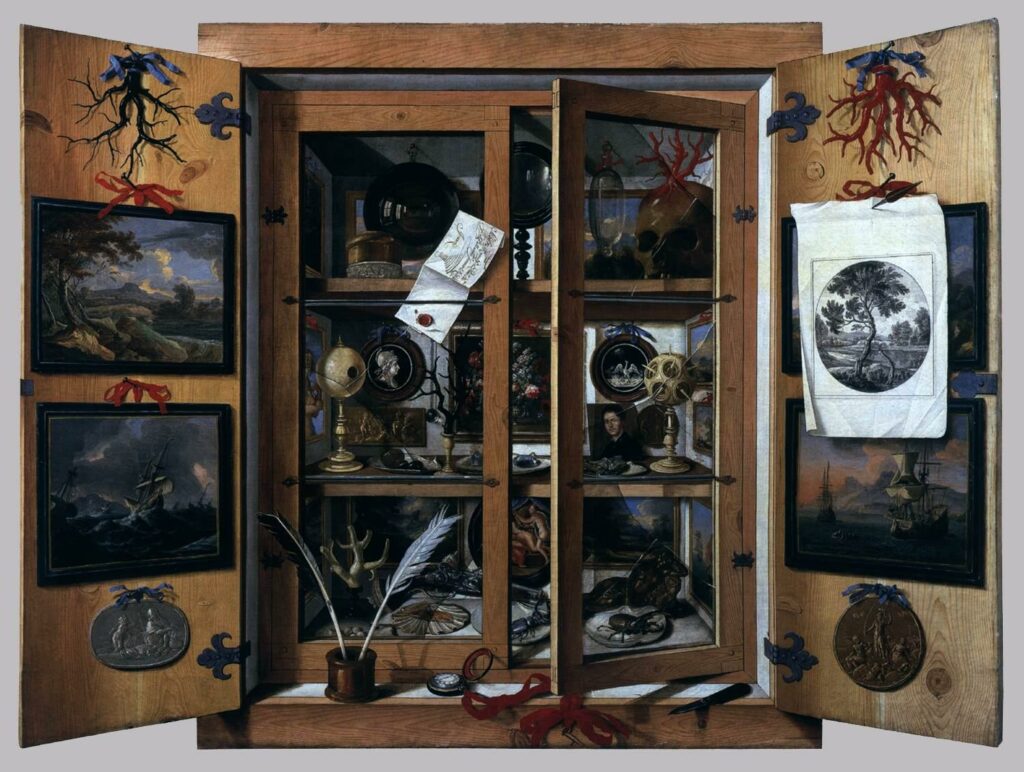
Many travellers wished to make their experiences visible after returning home. Wealthy collectors therefore established so-called Cabinets of Curiosities, or Wunderkammern, within their residences, where art, nature and science were brought together.

Typical objects included minerals, fossils, shells, antiquities, exotic artefacts, scientific instruments and archaeological finds
Within a single cabinet, a visitor might encounter Roman coins displayed alongside volcanic stones from Naples or fossils from distant lands. These collections reflected a period in which science, travel and art remained closely interconnected.
Intaglios and Cameos: The Most Popular Souvenirs
Among the most sought-after souvenirs were small engraved stones.
Intaglios are stones into which an image is carved in recessed form, whereas cameos rely upon relief carving and contrasting layers of colour within the material itself. These objects were compact enough to transport easily, relatively durable and strongly associated with classical antiquity.
Commonly used materials included carnelian, sardonyx, chalcedony, onyx and jasper.
Initially, travellers collected genuine antique examples, but before long a substantial production of newly made pieces emerged specifically for Grand Tour visitors. Today, these eighteenth- and nineteenth-century reproductions have themselves become important historical collectors’ items.
For glyptic art — the engraving of hardstones — certain materials proved especially suitable. Sardonyx, carnelian, chalcedony and onyx all belong to the microcrystalline varieties of quartz. Their fine crystal structure made them ideal for detailed engraving, signet stones and cameos. Layered stones such as sardonyx were especially prized because artists could use the contrasting colours to create depth and dramatic visual contrast.


Volcanic Tourism and Souvenirs from Vesuvius
By the late eighteenth century, Naples had become something of a centre for volcanic tourism. A visit to Mount Vesuvius became an established part of the Grand Tour for many travellers.
Some visitors undertook nocturnal ascents in order to witness glowing lava flows or vast clouds of smoke. Guides escorted travellers to the edge of the crater while selling souvenirs along the route.
Many visitors brought home volcanic material such as fragments of lava, sulphur, obsidian, volcanic minerals and vesuvianite. These objects transformed a fleeting experience into a tangible memory.
The Grand Tour coincided with the Age of Enlightenment, during which science increasingly shaped the way people collected and interpreted objects. The British diplomat and collector Sir William Hamilton played an important role in this development.
During his stay in Naples, he studied Vesuvius extensively and assembled large collections of volcanic material. His publications helped popularise volcanology among the European elite. As a result, minerals were admired not only for their beauty, but also regarded as scientific objects worthy of study.

The Legacy of the Grand Tour
Many Grand Tour objects remained within families for generations before eventually becoming collectors’ items in their own right. Others disappeared into museums, aristocratic collections, or re-emerged centuries later on the art market.
It is precisely this history that makes these objects so fascinating today. They tell us not merely about art or minerals, but about travel, curiosity, scientific discovery and the changing way Europeans began to view the wider world.
Perhaps that is the true legacy of the Grand Tour.
Sources
- Wilton, Andrew and Ilaria Bignamini, Grand Tour: The Lure of Italy in the Eighteenth Century
- Black, Jeremy, The British Abroad: The Grand Tour in the Eighteenth Century
- Cally Hall, DK Handbooks – Gemstones