In the first blog we explored how the Grand Tour became an essential part of the education of young aristocrats and wealthy travellers. Yet no destination captured the imagination quite like Naples.
For many travellers, Naples marked the final stage of their Italian journey and perhaps its most unforgettable chapter.
Travelling to southern Italy in the eighteenth century was far from easy. Travellers from northern Europe had to choose between a long overland route or an unpredictable voyage by sea. Sea travel meant bad weather, seasickness and sometimes even the threat of piracy. Travelling by land was hardly more comfortable. Roads were poor, journeys were slow and during winter parts of the Alps could become almost impassable.
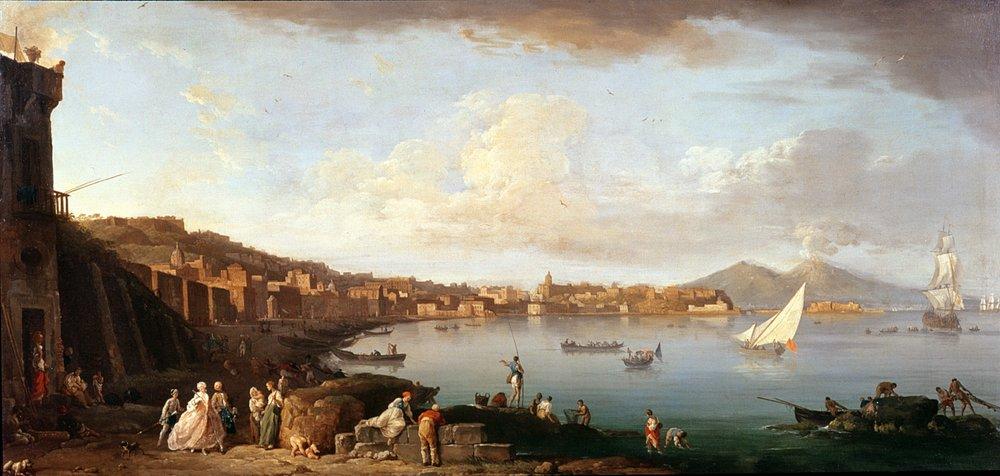
That is precisely why arriving in Naples felt like a reward. Suddenly the famous bay appeared, with Vesuvius constantly dominating the horizon. From the higher parts of the city visitors could look out across Capri, Ischia, Procida and the endless movement of ships entering and leaving the harbour.

In the eighteenth century Naples was one of Europe’s largest cities and a thriving commercial centre. Merchant ships, fishing boats, diplomats, artists and travellers all mixed together in a city that could be chaotic, wealthy, poor, elegant and rough all at once.
Not everyone admired Naples. Some travellers found the population noisy and the city untidy. Others fell in love with its spontaneous street life and dramatic surroundings.
That feeling has hardly changed. Naples remains a city that provokes strong reactions: people either love it or struggle with it.
Yet almost everyone was impressed by the attractions surrounding the city.
Excursions included Pompeii, Herculaneum, Paestum, the Campi Flegrei, Lake Avernus, the Palace of Caserta and of course Vesuvius itself.

For many Grand Tour travellers, Naples was not merely a destination. It was an experience.
But how do you take such an experience home? In the next blog we look at the objects travellers collected: from intaglios and cameos to volcanic stones, minerals and curiosities.
Sources
- Wilton, Andrew and Ilaria Bignamini, Grand Tour: The Lure of Italy in the Eighteenth Century
- Black, Jeremy, The British Abroad: The Grand Tour in the Eighteenth Century